"We hold these truths to be self-evident, that all men are created equal, that they are endowed by their Creator with certain unalienable Rights, that among these are Life, Liberty and the pursuit of Happiness."
 This sentence from the United States Declaration of Independence is said to be one of the most impacting statements in American history. It came to represent a moral standard to which the United States should strive. The declaration promoted independence and deviance against oppressive authority, it asserts certain natural and legal rights including the right of revolution, and it proclaims these truths to be self-evident. To study truth is to have insight into how this great country was founded. Our forefathers knew the truth and the idea that truth is self-evident.
"Because the knowledge of God is manifested, because God has shown it to them."3
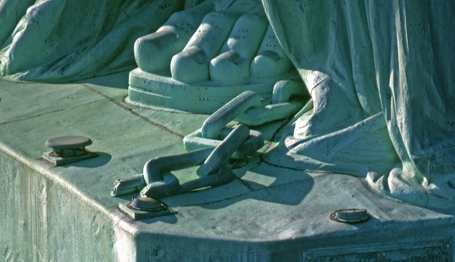
Self-evident truth is defined as truth that is evident without proof or reasoning; producing certainty or conviction upon a bare presentation to the mind; as, a self-evident proposition or truth.2 The knowledge of God was manifested to them, this word for manifested ephanerōsen is derived from phainó "to bring to light, to cause to appear" which has its root phos, "light, source of Light." The statue of Liberty is to be a beacon of truth to the world, a Light in darkness, she clutches truth and justice for all, and at her feet lie broken the chains of tyranny and oppression.
"For the wrath of God is revealed from heaven against all ungodliness and unrighteousness of men, who by their unrighteousness suppress the truth."4
What do unrighteous men do? they suppress the truth. How can truth be self-evident, when it is suppressed? The nature of truth is that it shines like a lamp placed upon on a lamp-stand, therefore truth is self-evident as it is presented, or propositioned for all to see. Faith has a root word that means to be persuaded thus the idea of truth as being self-evident is that truth is placed upon a lamp-stand and the truth itself, draws and persuades men.
"nor do they light a lamp and put it under a basket, but upon a lamp-stand, and it shines for all those in the house."5
Suppressing truth is to not speak of it, or to cover it up. The opposite of truth is a lie, so a false witness, deception, these things counter truth, thus it is considered evil. Often deception leads others away by containing partial truth, thus understanding is important. Those who walk in lies walk in darkness, thus one can not walk in darkness and light at the same time, if the eye is dark the whole body is. A house divided would be one that says it does evil for good, or one that calls evil good. One that covers wrong suppresses truth and since truth is Light, then not bringing to light a lie is allowing darkness. The truth dispels darkness thus those who see darkness and do nothing do not dispel darkness. To call truth evil or evil good is a sign of the end times.
"... who by their unrighteousness suppress the truth."
Unrighteous men suppress truth, and we see the nature of truth is as a lamp or Light. So we come to have more understanding of truth being self-evident. Truth really doesn't need to be defended, only that it is placed upon a lamp-stand, so that when people hear the truth, they can receive the truth. It is those who seek to understand truth that see through the lies. Authority can suppress truth by demanding obedience without understanding, without persuasion, a "blind" type of obedience, even if claimed to be truth of God, such will enslave not give Liberty to men.
"Therefore whatever you have said in the dark shall be heard in the light, and what you have whispered in private rooms shall be proclaimed on the housetops."6
Nothing that is hidden stays hidden, as all will be revealed in the Light. We see authority with its rule upon rule, line upon line, and for what purpose? but to suppress the truth and the people. These lord over others saying they have authority, even that such is from God, and that truth is obtained by them, a few in secret rooms. But the Truth states that all men are created equal, thus all men who seek the truth will find it self-evident. We are a far cry from where our founding forefathers envisioned. But let us hold up a Light, that truth will break free oppression and tyranny. Truth is not demanded nor dictated, it can not be forced upon people. Perhaps that which claims to be Light is not light or has become dim, surely truth should not be suppressed in the very house it should be self-evident.
"Because the knowledge of God is manifested, because God has shown it to them."3
Self-evident truth is defined as truth that is evident without proof or reasoning; producing certainty or conviction upon a bare presentation to the mind; as, a self-evident proposition or truth.2 The knowledge of God was manifested to them, this word for manifested ephanerōsen is derived from phainó "to bring to light, to cause to appear" which has its root phos, "light, source of Light." The statue of Liberty is to be a beacon of truth to the world, a Light in darkness, she clutches truth and justice for all, and at her feet lie broken the chains of tyranny and oppression.
"For the wrath of God is revealed from heaven against all ungodliness and unrighteousness of men, who by their unrighteousness suppress the truth."4
What do unrighteous men do? they suppress the truth. How can truth be self-evident, when it is suppressed? The nature of truth is that it shines like a lamp placed upon on a lamp-stand, therefore truth is self-evident as it is presented, or propositioned for all to see. Faith has a root word that means to be persuaded thus the idea of truth as being self-evident is that truth is placed upon a lamp-stand and the truth itself, draws and persuades men.
"nor do they light a lamp and put it under a basket, but upon a lamp-stand, and it shines for all those in the house."5
Suppressing truth is to not speak of it, or to cover it up. The opposite of truth is a lie, so a false witness, deception, these things counter truth, thus it is considered evil. Often deception leads others away by containing partial truth, thus understanding is important. Those who walk in lies walk in darkness, thus one can not walk in darkness and light at the same time, if the eye is dark the whole body is. A house divided would be one that says it does evil for good, or one that calls evil good. One that covers wrong suppresses truth and since truth is Light, then not bringing to light a lie is allowing darkness. The truth dispels darkness thus those who see darkness and do nothing do not dispel darkness. To call truth evil or evil good is a sign of the end times.
"... who by their unrighteousness suppress the truth."
Unrighteous men suppress truth, and we see the nature of truth is as a lamp or Light. So we come to have more understanding of truth being self-evident. Truth really doesn't need to be defended, only that it is placed upon a lamp-stand, so that when people hear the truth, they can receive the truth. It is those who seek to understand truth that see through the lies. Authority can suppress truth by demanding obedience without understanding, without persuasion, a "blind" type of obedience, even if claimed to be truth of God, such will enslave not give Liberty to men.
"Therefore whatever you have said in the dark shall be heard in the light, and what you have whispered in private rooms shall be proclaimed on the housetops."6
Nothing that is hidden stays hidden, as all will be revealed in the Light. We see authority with its rule upon rule, line upon line, and for what purpose? but to suppress the truth and the people. These lord over others saying they have authority, even that such is from God, and that truth is obtained by them, a few in secret rooms. But the Truth states that all men are created equal, thus all men who seek the truth will find it self-evident. We are a far cry from where our founding forefathers envisioned. But let us hold up a Light, that truth will break free oppression and tyranny. Truth is not demanded nor dictated, it can not be forced upon people. Perhaps that which claims to be Light is not light or has become dim, surely truth should not be suppressed in the very house it should be self-evident.